
The Effect of Valve Jacket Use on Energy Savings: Comprehensive Guide for Industrial Facilities
Introduction
In today's world, where energy costs are constantly increasing, every solution that provides efficiency in industrial facilities is of strategic importance. Especially in refineries, petrochemicals, and power plants, heat losses can lead to serious financial losses. One of the prominent solutions at this point is valve jacket (valve insulation jacket) applications.
Heat losses occurring at valves, flanges, and equipment points are often ignored. However, these points constitute a significant part of the total energy loss. A correctly designed and applied valve jacket system provides energy savings and makes important contributions in terms of occupational safety and equipment life.
What is a Valve Jacket?
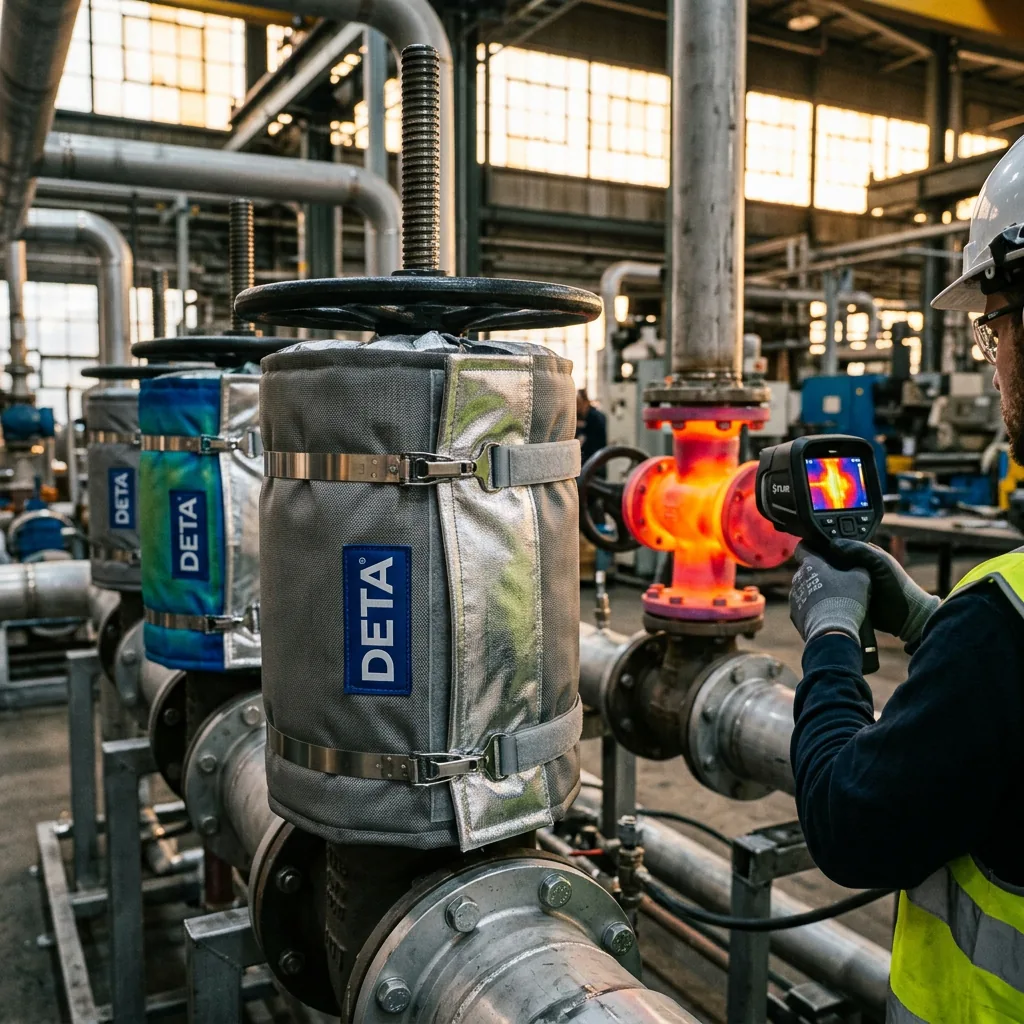
A valve jacket is a removable and reusable insulation system applied on valves, flanges, pumps, and similar equipment. The biggest difference from standard insulation is that it can be easily removed and reinstalled during maintenance processes.Performance and ROI
Valves and flanges often remains as "weak links" in industrial facilities and cause significant energy loss. Valve jackets minimize this loss and ensure a rapid return on investment.
Rapid ROI
Valve jacket investments usually pay for themselves in a short period such as 6 to 12 months thanks to the energy savings they provide.Heat Loss Control
It lowers fuel consumption and stabilizes process temperature by minimizing the heat radiating from the equipment surface to the environment.Occupational Safety
It reduces the risk of personnel burns by covering high-temperature surfaces and offers a safer working environment.Modular Design
Thanks to its flexible structure, it speeds up maintenance processes; unlike traditional insulation, it prevents material waste every time.Valve Jacket Types and Application Areas
The success of the system depends on the selection of materials suitable for environmental conditions and temperature.
- High Temperature Jackets: Ceramic fiber-based solutions for applications at 500°C and above.
- Medium Temperature Jackets: Ideal protection for steam lines and standard process equipment.
- Cold Line Jackets: Structures that prevent condensation and increase efficiency in cooling systems.
Design Criteria
Correct thickness calculation and custom-sized production that fits perfectly on the valve surface are vital for maximum energy saving. In case of incorrect dimensioning, heat leaks will continue.Quality Control and Modern Solutions
Modern techniques should be used to verify the performance of the system. In particular, Thermal Camera Analysis is the most effective method for detecting invisible heat leaks after installation.
COMMON MISTAKE: Low Quality Material
The use of uncertified and non-durable material causes the jacket to deform in a short time and lose its insulation property. Material suitable for technical specifications must be selected for the success of the investment.Conclusion: A Strategic Energy Investment
Valve jackets are one of the most practical and effective steps that facilities can take to reduce energy costs. It is not just an insulation material but a strategic engineering solution that directly increases process efficiency.
Deta Insulation Team
This content has been prepared and verified by Deta Industrial technical experts.