

Hidden Energy Losses in Steam & Thermal Oil Lines: Calculating Valve Jacket Payback & Heat Savings
In heavy industrial plants, petrochemical complexes, textile mills, and power stations, pipe runs are meticulously lagged with mineral wool and sheet metal cladding. Yet critical valves, flanges, strainers, and expansion joints are frequently left bare (uninsulated) due to routine servicing and inspection needs.
Thermodynamic engineering reveals an alarming reality: A single bare DN100 (4") valve radiates as much thermal energy as 3.5 to 5 linear meters of uninsulated bare pipe. In a plant operating hundreds of valves, this translates to tens of thousands of cubic meters of natural gas vented into the atmosphere annually.
How can plant managers calculate this hidden loss and determine the exact investment payback (ROI) using international standards?
1. DetaTherm™ Valve Jacket Calculator User Manual
DetaTherm™ is a digital thermodynamic simulation engine engineered in compliance with VDI 2055 and DIN EN ISO 12241. It computes convective and radiant heat dissipation, annual fuel waste, and exact investment payback (ROI) in seconds.
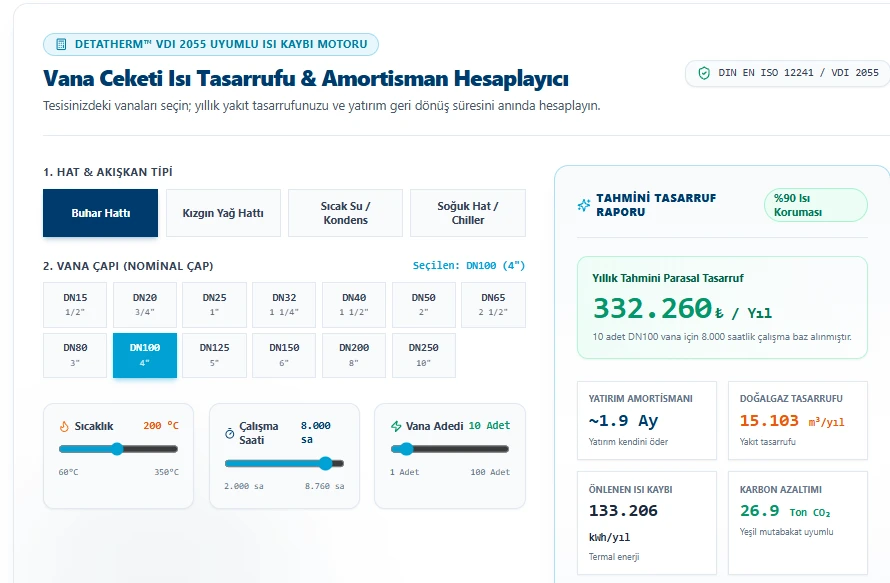
Step-by-Step Simulation Guide
1. Select Line & Fluid Medium
- Steam Line: Default 200°C. High enthalpy and radiation rate (Fluid Multiplier: 1.05).
- Thermal Oil Line: Default 260°C. High-temperature process lines reaching 300°C+ (Multiplier: 1.10).
- Hot Water / Condensate: Default 95°C. Low to medium temperature circuits (Multiplier: 0.95).
- Chilled Water / Cooling: Default 6°C. Condensation control and thermal gain prevention (Multiplier: 0.85).
2. Select Valve Nominal Diameter (DN)
The module automatically applies VDI 2055 equivalent surface area formulas:
- DN15 (1/2") – DN25 (1"): Instrumentation and drain valves (0.058 – 0.106 m²).
- DN32 (1 1/4") – DN50 (2"): Branch process lines (0.135 – 0.201 m²).
- DN65 (2 1/2") – DN100 (4"): Main distribution and manifold headers (0.260 – 0.515 m²).
- DN125 (5") – DN250 (10"): Primary trunk lines (0.660 – 1.620 m²).
3. Adjust Operating Temperature & Annual Hours
- Temperature Slider: Set the exact fluid temperature (60°C to 350°C).
- Annual Operating Hours: Configure shift schedule (Single Shift: 2,000h | Continuous 24/7 Heavy Industry: 8,000h).
4. Enter Valve Quantity
Select the number of identical valves on the system (1 to 100+ units).
Reading Output Metrics
| Output Metric | Unit | Engineering Interpretation |
|---|---|---|
| Annual Financial Savings | $ / Year | Direct fuel savings credited to operating cash flow. |
| Investment Payback (ROI) | Months | Time required for energy savings to offset capital expenditure (typically 1.9 – 3.5 months). |
| Heat Loss Prevented | kWh / Year | Net thermal energy conserved via 90% insulation efficiency. |
| Natural Gas Saved | m³ / Year | Fuel conserved factoring 10.64 kWh/m³ LHV and 83% boiler efficiency. |
| Carbon Reduction | Tons CO₂ | Avoided greenhouse emissions (0.202 kg CO₂/kWh). |
| HSE Surface Safety | < 45°C | Outer jacket temperature reduced to touch-safe threshold. |
2. VDI 2055 Mathematical Formulation
The engine executes standard VDI 2055 and ISO 12241 convection-radiation equations:
Qloss = h × Avalve × (Tfluid - Tambient)
Where h = (10 + 0.05 × ΔT) × Fluid Factor [W/m²K].
Natural Gas Saved (m³) = Saved Thermal Energy (kWh) / (10.64 × 0.83) = kWh / 8.82
3. Real-World Case Study: 10 x DN100 Steam Valves
- Operating Conditions: 200°C saturated steam, 20°C ambient, 8,000 hrs/year.
- Component Count: 10 bare DN100 (4") globe valves.
- Conserved Energy: 133,206 kWh/year thermal energy retained.
- Fuel Recovered: 15,103 m³/year natural gas saved.
- Decarbonization: 26.9 Tons CO₂/year eliminated.
- Payback Period: ~1.9 Months full capital recovery.
4. Manufacturer Direct Assurance & E-E-A-T
- Dual Production Facilities: 10,000 units/month production capacity across our Istanbul & Bursa workshops.
- 1260°C Extreme Temperature Core: Pyrogel® XT aerogel, ceramic fiber, and high-density rockwool tailored to thermal regimes.
- CUI Mitigation: Hydrophobic PTFE/silicone technical fabrics eliminate moisture ingress and allow rapid NDT visual inspection.
Frequently Asked Questions (FAQ)
1. How much energy does an uninsulated valve waste annually?
According to VDI 2055, a single bare DN100 valve operating on a 200°C steam line dissipates as much heat as 3.5 to 5 meters of uninsulated pipe, wasting over 13,300 kWh of thermal energy and ~1,500 m³ of gas annually.
2. Which standards govern the DetaTherm™ Calculator?
DetaTherm™ executes calculation models defined in VDI 2055, DIN EN ISO 12241, and ASTM C 1129-12 standards.
3. What is the typical ROI period for valve insulation jackets?
In continuous industrial operation (7/24 regime), payback is achieved within 1.9 to 3.5 months.
Run Your Plant Simulation Now
👉 Launch DetaTherm™ Valve Jacket Calculator
Request an on-site thermal survey and official factory quotation from Our Engineering Team.
DetaTherm Engineering Team
This content has been prepared and verified by Deta Industrial technical experts.