

Alcohol Storage Tank Insulation in Food & Beverage Facilities: Removal, Blasting, Painting & Polyurethane Cladding Guide | Deta Industry
Alcohol Storage Tank Insulation in Food Facilities: Removal, Sandblasting, Painting & Polyurethane Cladding Guide
In the food and beverage industry, storage tanks holding beer, wine, distilled spirits, and pure ethyl alcohol must be maintained in tight temperature regimes (+2°C to -4°C or strictly climate-controlled) to preserve product chemistry. However, aged or poorly detailed insulation on these vessels causes condensation accumulation, massive refrigeration energy loss, and severe Corrosion Under Insulation (CUI) leading to tank wall perforation.
Deta Industry outlines the engineering phases, field execution protocols, and critical technical checkpoints from our turnkey alcohol storage tank renovation project successfully completed at a major beverage manufacturing facility.
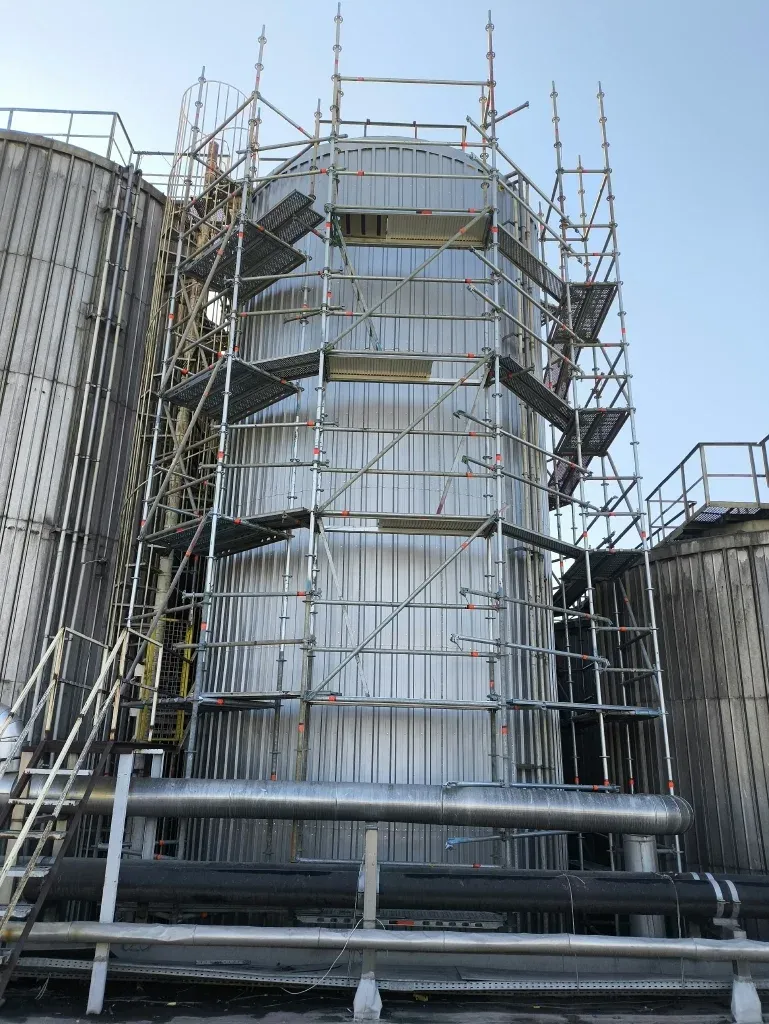
Step 1: Secure Working Platform & Modular Scaffolding Erection
The first operational phase establishes complete 360-degree safe access around the cylindrical tank shell and domed roof:
- Scaffolding System: Industrial ringlock modular scaffolding configured with curved cantilever brackets precisely hugging the circular tank circumference.
- Safety Standard: Erected in strict compliance with TS EN 12810 / TS EN 12811 standards, utilizing non-combustible steel decks to satisfy the food plant's hygiene and fire safety protocols.
- HSE Verification: Dual-lanyard 100% tie-off lifeline systems on the dome head and daily Scaff-Tag inspection protocols prior to every shift.
Related Service: Explore our comprehensive scaffolding contracting on our Industrial Scaffolding Engineering page.
Step 2: Wet Insulation Stripping & Hygienic Waste Disposal
Old mineral wool/fiberglass insulation that had become saturated with ambient condensation, rainwater, and high-pressure plant washdown was systematically removed:
- Wet insulation loses 100% of its thermal efficiency and holds moisture directly against the carbon steel shell, creating severe localized pitting corrosion.
- To prevent airborne particulate contamination within the food production perimeter, stripped materials were immediately bagged and evacuated via sealed chutes.
Step 3: Mechanical Maintenance, Sa 2.5 Sandblasting & Epoxy Sealing (The Critical Step!)
The most catastrophic error observed across industrial sites is injecting or spraying polyurethane foam directly over corroded, unprepared, or unprimed tank steel.
The cascading failure mechanism caused by improper surface preparation and unprimed insulation:
Applying foam without Sa 2.5 blasting and chemical-resistant epoxy primer
Thermal expansion separates foam from substrate, trapping condensation
Moisture cell triggers aggressive pitting corrosion until tank walls breach
Engineering Rationale: Why Surface Coating is Non-Negotiable
Without an engineered primer barrier, natural thermal expansion and contraction cycles cause polyurethane foam to delaminate from the steel substrate. Trapped condensation in the resulting micro-voids triggers rapid Corrosion Under Insulation (CUI). Because the vessel is encased in external metal jacketing, this structural damage remains invisible until the tank shell perforates and leaks!
Deta Standard Protocol:
- Abrasive Blasting (ISO 8501-1 Sa 2.5): Complete removal of mill scale, rust, and legacy coatings, establishing a 50–75 µm anchor profile.
- Anti-Corrosion Primer: Application of a high-solids, chemical-resistant epoxy barrier primer strictly applied while substrate temperature remains at least +3°C above dew point.
- Hermetic Seal: Steel is 100% isolated from moisture and oxygen, eliminating CUI risk at the root.
Related Service: Learn more about protective barrier coatings on our Industrial Painting Services page.
Step 4: Protective Metal Cladding & Precision Overlapping
To shield the core insulation from ambient weathering, UV exposure, and daily chemical washdowns, an engineered metal jacket was installed:
- Material: Corrosion-resistant embossed aluminum/stainless steel sheet metal.
- Gravity Overlap Protocol: Cladding sheets were overlapped from bottom to top with a minimum 40–50 mm overlap, ensuring all water cascades naturally downward.
- Hermetic Sealing: All horizontal and vertical seam joints were sealed with elastomeric food-grade mastic and pop-riveted to prevent water ingress.
Step 5: On-Site Rigid Polyurethane Injection & Commissioning
High-density rigid polyurethane foam was injected into the annular cavity between the primed tank shell and outer metal cladding:
- Thermal Performance: Polyurethane delivers an outstanding thermal conductivity ($\lambda$) of 0.022 – 0.024 W/mK, nearly twice the insulating efficiency of equal-thickness mineral wool.
- Monolithic Core: In-situ expansion fills every weld bead, nozzle junction, and curvature without seams, completely eliminating thermal bridges.
- Energy Savings: Achieved an audited up to 35% reduction in refrigeration compressor electrical consumption, with the tank delivered in zero-defect condition.
Comparative Matrix: Mineral Wool vs. Deta In-Situ Polyurethane System
| Technical Parameter | Traditional Mineral Wool | Deta Polyurethane + CUI Protection System |
|---|---|---|
| Thermal Conductivity (λ) | 0.038 – 0.044 W/mK | 0.022 – 0.026 W/mK (Superior Efficiency) |
| Moisture Absorption | High (collapses when wet, accelerates CUI) | Closed-cell structure (>90%), zero water absorption |
| Steel Corrosion Protection | Often wrapped over unprimed bare steel | Sa 2.5 Blasting + High-Solids CUI Epoxy Seal |
| Jacket Detailing | Basic unsealed seams | Precision Overlapping & Mastic Seam Lock |
| Operating Lifespan | 3 – 5 Years (Vulnerable to washdowns) | 15 – 20+ Years Continuous Service |
Frequently Asked Questions (FAQ)
1. Why is rigid polyurethane the preferred insulation for alcohol tanks?
Its closed-cell structure prevents vapor diffusion and moisture absorption, eliminating sweating and condensation on cold alcohol tanks while maximizing thermal efficiency in minimal wall thicknesses.
2. Is sandblasting and epoxy priming mandatory before foam insulation?
Yes, absolutely. Unprimed steel experiences foam delamination under thermal cycling. Trapped moisture triggers CUI that can puncture tank walls. Sa 2.5 blasting and epoxy priming safeguard the structural investment.
3. What is the importance of cladding sheet overlapping?
Proper gravity overlapping (bottom-to-top) and silicone mastic joint sealing prevent washdown detergents and rainwater from penetrating into the core insulation.
Engineering Verification & Quality Standards:
This technical methodology conforms strictly to VDI 2055, TS EN 12811, and ISO 12944 standards, verified by the Deta Industry Technical Insulation & Corrosion Engineering Team. For tank insulation audits in food and beverage plants, Contact Our Engineers.
Deta Painting Team
This content has been prepared and verified by Deta Industrial technical experts.