
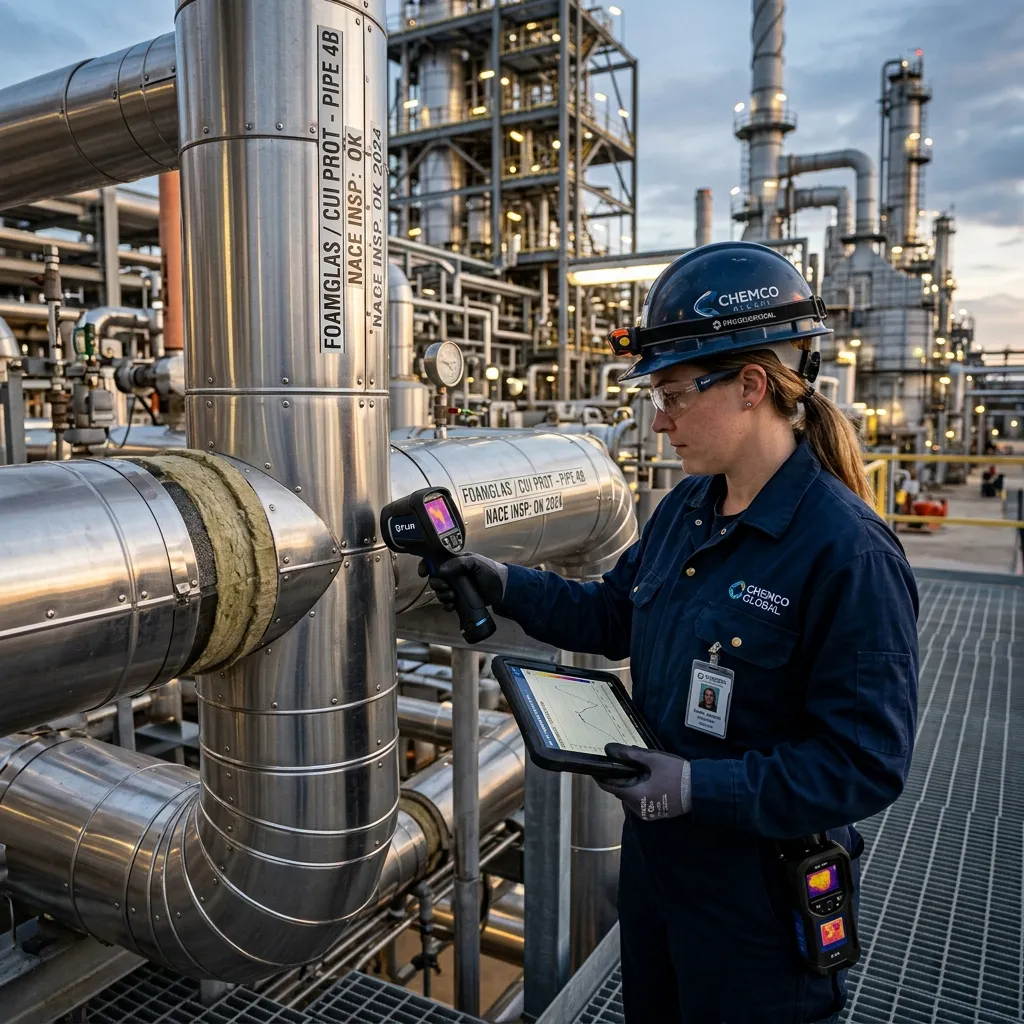
Industrial Insulation and CUI Management in Refineries and Heavy Industry: Comprehensive Engineering Guide
Industrial Insulation and CUI Management in Refineries and Heavy Industry: Engineering Guide for Critical Facility Integrity
Heavy industry, petrochemical plants, power plants, and LNG storage areas are zero-tolerance complexes where thermodynamic laws operate without compromise. Protecting the temperature of fluids passing through thousands of kilometers of pipelines and massive reactors in these facilities is not just a matter of energy saving; it is a vital engineering discipline directly related to process control, facility integrity, and personnel safety.
Deta Endüstri: For project-specific solutions and detailed information, you can review our Industrial Scaffolding Rental and Installation Services page.
Insulation applications are one of the highest priority items for facility managers and technical offices. Because an incorrectly selected insulation material or a faulty application can trigger the insidious danger called CUI (Corrosion Under Insulation), leading to a disaster for the facility.
In this in-depth guide, we present the technical standards of industrial insulation (ASTM F683-03a), common errors made in the field, corrosion risks, and the digital power of our DetaTherm software in thermal calculations, blended with our field experience.
What is Industrial Insulation and Why is it Vital?
Industrial insulation refers to engineering systems applied to prevent thermal energy losses in pipelines, reactors, and tanks in refineries and power plants, stop the risk of Corrosion Under Insulation (CUI), and ensure personnel safety (burn protection) by bringing surface temperatures to levels compliant with standards. It is constructed using materials such as cellular glass, rockwool, aerogel, or polyurethane depending on the operating temperature of the system, integrated with a leak-proof metal outer cladding (jacketing).
1. Technical Anatomy of Industrial Insulation and Standards
Insulation is not just about wrapping a material around a pipe; it is a complex engineering design where thermal bridges, dew point temperatures, and water vapor diffusion resistances are calculated.
ASTM-F683 Standards and OHS Norms
According to internationally accepted ASTM-F683 standards, all lines carrying gas, steam, or liquid outside the 13°C – 52°C temperature range must be insulated. One of the most fundamental rules is personnel protection. The insulation design should be designed to keep the outer surface temperature at a maximum of 65°C on non-metallic surfaces and 55°C on metallic-clad surfaces.
Critical Material Selection
- Cellular Glass: An inorganic material that operates between -260°C and +430°C, has zero water absorption, and is unrivaled especially in areas where CUI risk is high.
- Rockwool: Preferred in lines requiring high temperature and fire insulation up to 800°C. However, due to its hygroscopic nature, it must be protected with a flawless outer cladding.
- Aerogel Insulation: A modern solution preferred in facilities with space constraints, offering superior thermal performance even at very low thicknesses.
2. CUI (Corrosion Under Insulation) Management: The Invisible Danger
The biggest enemy of industrial insulation is CUI. Water and moisture entering the insulation come into contact with the metal surface and initiate an insidious corrosion that is invisible from the outside.
Specifically, operating temperatures between 60°C and 120°C are the "deadly temperature band" where the corrosion rate reaches its maximum level. In lines in this range, non-absorbent materials (such as cellular glass) should be preferred, and sealing details should be applied in double layers.
3. Top 3 Critical Errors Made in the Field
Our field experiences show that the following errors turn insulation into a destruction mechanism rather than a protector:
- Vapor Barrier Violation in Cold Lines: Failure to provide sealing at the joints of vapor barrier mastics in cryogenic lines causes the entering air to condense, filling the insulation with water and turning the system into an ice ball.
- Thermal Bridges in Pipe Supports: Crushing of insulation at the points where pipes sit on steel supports creates a massive thermal bridge. High-compressive-strength blocks should be used at these points.
- Incorrect Insulation of Valves and Flanges: Closing valves that require maintenance with fixed cladding leads to these areas being left uninsulated after maintenance. The solution is removable insulation jackets.
4. Digital Transformation in Thermal Insulation with DetaTherm and DetaPlan
The era of traditional Excel calculations in industrial insulation projects is over. Deta Industry transforms this process into fully digital engineering.
DetaTherm: Thermal Analysis Engine We don't leave insulation decisions to chance in your projects. Our DetaTherm software performs 3D heat loss calculations by extracting the digital twin of your facility in ASME and ASTM standards. It verifies the compliance of surface temperatures with OHS norms and reports the Return on Investment (ROI) rate of the selected material.
DetaPlan: Flawless Field Access For this calculated perfect insulation to be safely applied on a reactor at a height of 40 meters, our DetaPlan scaffolding planning software comes into play. We design scaffolding systems optimized with collision analyses in a 3D environment so that insulation teams can safely reach the most challenging points.
Conclusion and Call to Action
Insulation in heavy industry and refineries is not a simple consumable item; it is the most critical engineering armor protecting the veins of the facility. Incorrect material selection and application deficiencies lead to tens of thousands of dollars in energy loss and unplanned shutdowns.
To zero out thermal losses and eliminate CUI risks in your facility, contact our expert team that digitalizes your insulation processes with DetaTherm and your field access with DetaPlan. Protect your facility with the power of science.
Frequently Asked Questions (FAQ) - Google 2026 Standards
1. Why is CUI (Corrosion Under Insulation) so dangerous? Because CUI progresses under the insulation, it cannot be noticed from the outside. While the equipment looks sound from the outside, the metal wall thickness drops to a critical level, causing sudden explosions. Action: Plan periodic NDT (Non-Destructive Testing) in risky areas.
2. What should be considered besides the thermal conductivity coefficient (λ) when choosing an insulation material? The water absorption rate, fire resistance, and water vapor diffusion resistance (µ) of the material are at least as critical as the thermal conductivity coefficient. Technical Note: Prioritize closed-cell materials in humid environments.
3. Why should removable jacket insulation be used on valves and flanges? Fixed insulation is destroyed during maintenance and is usually not put back on. Removable jackets, on the other hand, provide ease of maintenance while continuously preventing heat loss and personnel burn risk. Suggestion: Examine our custom-design jackets for valve insulation.
4. How does DetaTherm software make a difference in cost management? DetaTherm calculates milimetrically how long a certain insulation thickness will amortize itself. In this way, you avoid unnecessary thickness increases or insufficient insulation risks. Financial Analysis: Request an ROI-focused thermal report.
5. Why is the formation of ice balls in cold lines an insulation failure? Icing means that the vapor barrier layer in the system has been punctured and water vapor has entered the insulation and frozen. Iced insulation no longer insulates; on the contrary, it conducts heat faster. Solution: Revise vapor barrier details.
Deta Scaffolding Team
This content has been prepared and verified by Deta Industrial technical experts.