
Scaffolding and Insulation in Refinery and Petrochemical Plants: Expert Guide
Scaffolding and Insulation in Refinery and Petrochemical Plants: Expert Guide
Heavy industry, refinery, and petrochemical plants are environments where occupational safety tolerance is zero, representing the physical world's equivalent of the YMYL (Your Money or Your Life) concept. The massive reactors, miles of complex pipelines, and spherical tanks in these facilities present unique challenges for industrial insulation processes.
Deta Endüstri: For project-specific solutions and detailed information, you can review our Industrial Scaffolding Rental and Installation Services page.
Correct insulation not only ensures energy efficiency but also guarantees that dangerous chemical reactions remain at optimum temperatures. However, the safe execution of these high-altitude insulation processes depends on a flawless scaffolding planning and installation process.
Expertise in the Refinery Sector
You can visit our Refinery Solutions page to examine the special solutions we offer for refinery and petrochemical plants. Every valve jacket and every pipeline insulation in these facilities directly affects your energy costs.
What is Industrial Insulation Scaffolding?
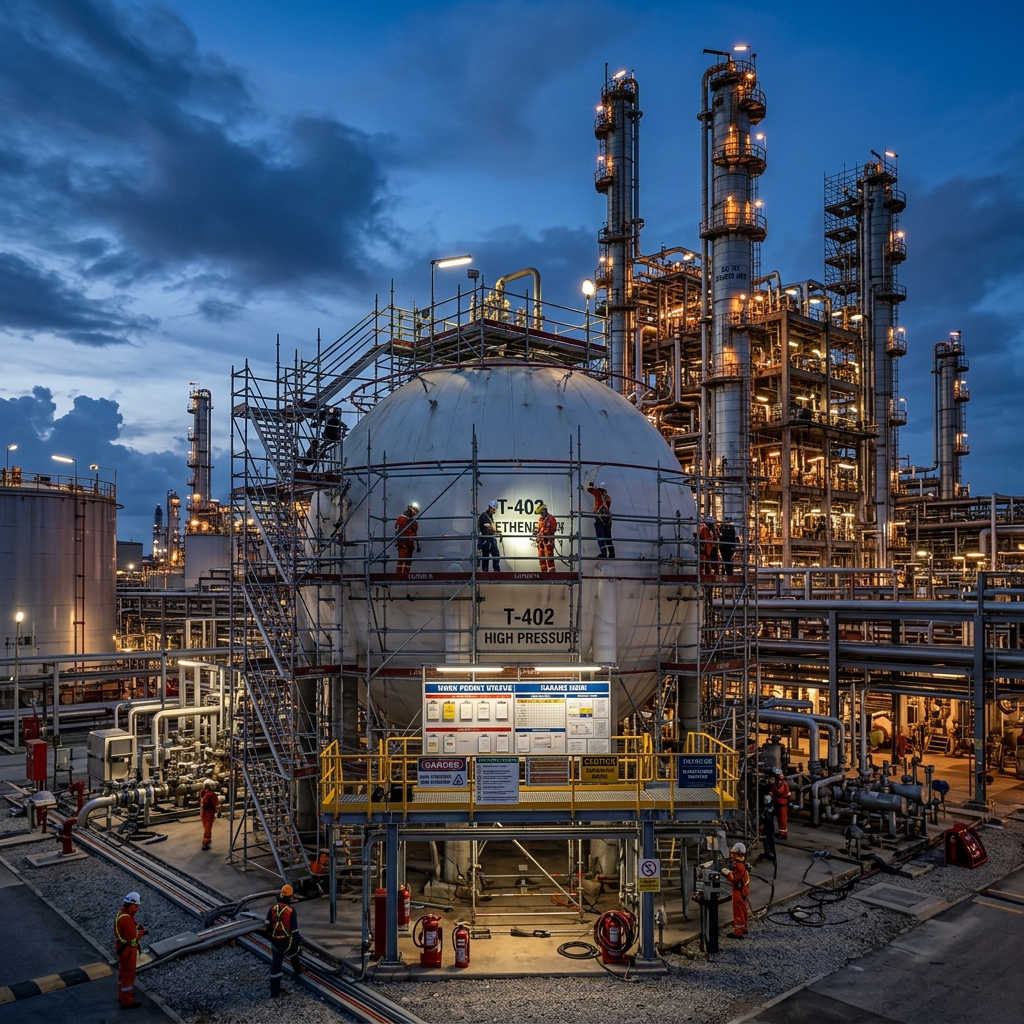
Industrial insulation scaffolding is a temporary access and work platform system built for the coating, maintenance, and insulation work of pipelines, reactors, and tanks in refinery and petrochemical plants. It has high load-bearing capacity and is fully compatible with TS EN 12810-1 and TS EN 12811-1 standards. It is constructed using modular flanged (wedge-connected) systems that can connect from 8 different angles to difficult geometric areas (spherical tanks, narrow pipe bridges).
1. Technical Anatomy of Scaffolding in Petrochemical Sites
Working in refineries does not just mean "working at height"; it is working at the heart of an active, hot, and chemical-risk facility. Therefore, the static calculations (TS EN 12810-2) and performance requirements (TS EN 12811-1) of the installed systems must be strictly applied.
Modular (flanged) scaffolding systems are preferred in these sites. For example, advanced flange technology allows us to perfectly encircle a spherical petrochemical tank. These systems provide great flexibility and offer a positive connection (locking) that prevents material stretching.
2. Site Application Process and Safety Parameters
While installing insulation scaffolding, the process starts on paper and becomes steel in the field. To provide a safe working environment according to basic standards, it is essential that the following equipment is complete:
- Main Guardrail: Installed horizontally at least 1 meter above the work level.
- Intermediate Guardrail: Installed between the main guardrail and the toe board at a height that a 470 mm diameter sphere cannot pass through.
- Toe Board (Skirting): Installed at least 15 cm above the work area level to prevent parts (insulation scissors, sheets, etc.) from falling from the edges of the work platform.
3. Top 3 Critical Errors Made in the Field
- Using Wedges Instead of Base Jacks: Using random wooden wedges to level the scaffolding on sloped ground is a fatal error.
- Incomplete Locking of Wedge Connections: Not fully hammering the wedges due to installation speed pressure.
- Stacking Insulation Load on Platforms Without Calculation: Platforms should not be loaded above the designed load class (usually Class 2 or 3).
4. Expert Opinion: Importance of Integrated Solutions
The most critical point we would say would be good if it happened: Scaffolding and insulation services being managed from a single professional hand instead of different subcontractors. This integrated approach we offer as Deta Industry minimizes scaffolding dismantling-installation times and speeds up your project by up to 25% by eliminating the waiting times of insulation teams.
5. Overcoming Limits with DetaPlan and DetaTherm Integration
In industrial projects, traditional and manual methods are now being replaced by digital twins and 3D design software. Programs like DetaPlan prevent material waste by extracting the quantity of necessary scaffolding components with millimetric precision on digital twins of complex petrochemical plants.
In addition, our DetaTherm software, which we offer completely FREE just like DetaPlan, adds a great engineering power to your projects by making insulation and heat loss calculations flawless. The use of FREE DetaTherm allows you to see your return on investment (ROI) from the very beginning.
Conclusion
Insulation and scaffolding applications in refinery and petrochemical plants are an engineering discipline where standards, correct materials, and experienced teams come together.
If there is an upcoming shutdown or maintenance period in your facility, contact our expert engineering team immediately to move your projects to the digital environment with DetaPlan and build reliable scaffolding systems.
Free Engineering Support
Use our **DetaPlan** and **DetaTherm** programs for free to reduce costs and increase safety in your next project.Get a Quote Now ←
Deta Scaffolding Team
This content has been prepared and verified by Deta Industrial technical experts.