
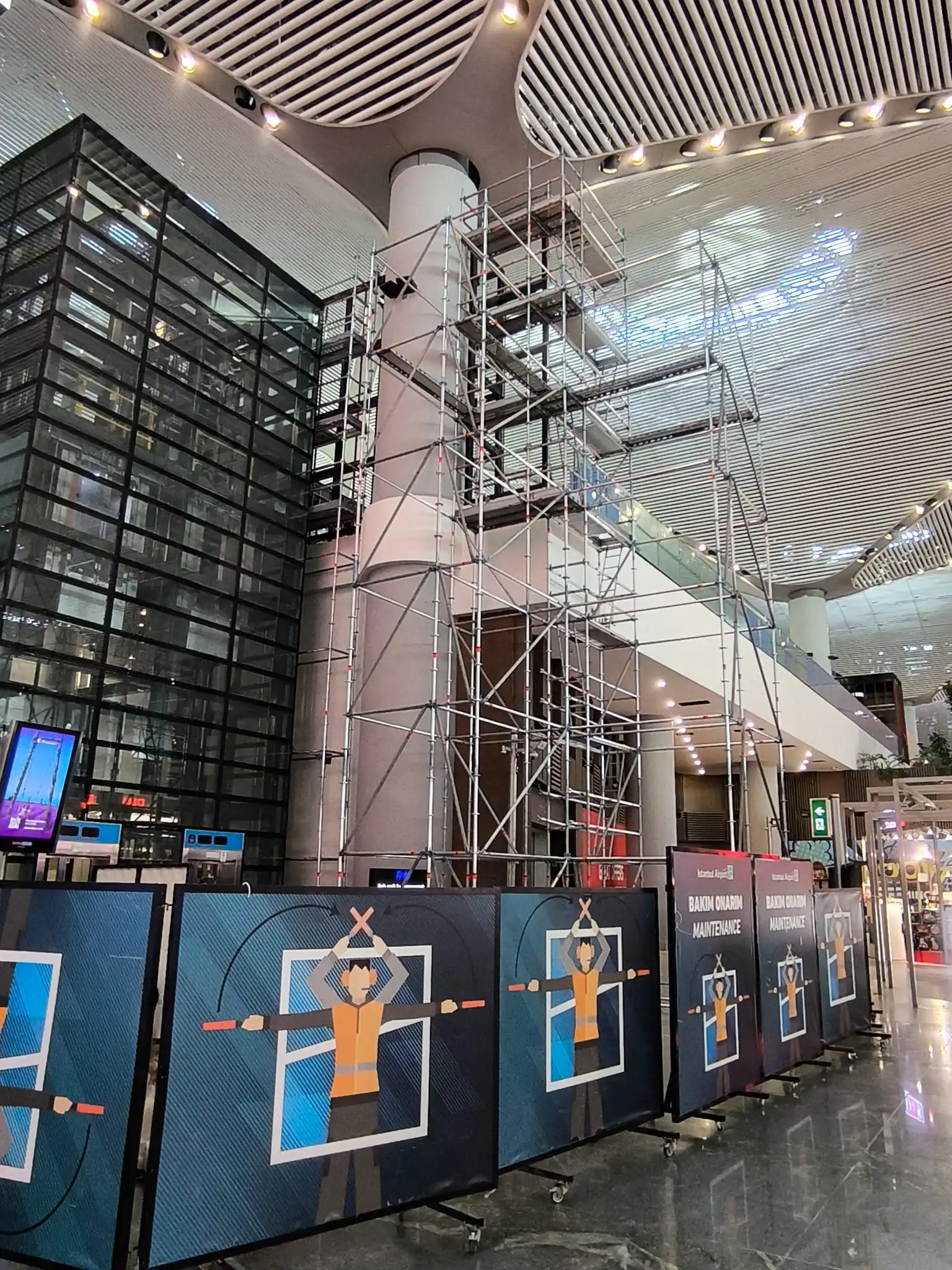
Airport International Terminal Renovation: Zero Accidents and Flawless Scaffolding Engineering with Layher Allround
Airport International Terminal Renovation: Zero Accidents and Flawless Scaffolding Engineering with Layher Allround
In the renovation project we carried out at the Airport International Terminal, actively used by millions of passengers, we completed our zero-accident goal with a flawless engineering operation using our Layher Allround® Ringlock Scaffolding systems strictly compliant with TS EN 12810 and TS EN 12811 standards.
1. High-Risk Management and Engineering Approach in an Active Terminal
Renovation works in areas like airports, which are active 24/7 with heavy circulation, require a much more complex risk management than ordinary construction site applications. We had to not only provide physical access but also guarantee passenger safety, avoid damaging the terminal architecture, and create safe platforms at enormous heights.
To overcome these challenges, our engineering team planned the process through DetaPlan 3D modeling software [4]. Thanks to the digital twin simulations made before installation, clash analyses were performed, and only the necessary materials were dispatched to the site, preventing logistical chaos and time loss inside the terminal [4, 5].
2. Why Layher Allround Ringlock Scaffolding for Complex Architectures?
Traditional scaffolding systems could not be used in the terminal's oval ceiling structures and wide spans. At this point, the pre-fabricated modular Layher Allround Scaffolding (Ringlock System), featuring high load-bearing capacities and screwless wedge-head connection technology, came into play [1].
- Eight-Way Connection Flexibility: Thanks to the special rosette (flange) structure, millimeter-perfect adaptation to complex terminal columns and ceiling slopes was achieved [1].
- Maximum Stability: When the wedge was pushed onto the flange, it was instantly secured with the "AutoLock" function, preventing vibration-induced loosening [1].
- Load Distribution and Floor Protection: To avoid damaging the terminal floor coverings, special load-distributing base plates were used, minimizing point pressure [6].
3. HSE Discipline: How Was "Zero Accidents" Achieved?
In this operation, "Zero Accidents" is not a matter of luck but the result of uncompromisingly applied safety procedures. The HSE and inspection steps we applied throughout the work are as follows:
- Scaff-tag (Scaffold Tagging) System: After the scaffold installation was completed according to TS EN 12811 norms, it was inspected by our expert engineers and certified with a "Green Tag" (Safe to Use) for authorized personnel [3].
- Fall Protection Systems: Using fully enclosed platforms, non-slip surfaces, double guardrails, and toe boards of at least 15 cm height, the risk of falling materials and tools was 100% prevented [7].
- Night Shift Logistics: For passenger safety, the transfer of heavy scaffolding equipment into the terminal was carried out during night hours when passenger traffic was at its lowest.
Conclusion: Engineering Speaks with Data, Safety with Proof
The Airport International Terminal renovation scaffolding project is an excellent proof of Deta Industry's field organizational capability, the power of Layher systems, and our uncompromising safety culture. The project was successfully delivered with no structural damage, zero occupational accidents, and ahead of schedule.
Deta Scaffolding Team
This content has been prepared and verified by Deta Industrial technical experts.