
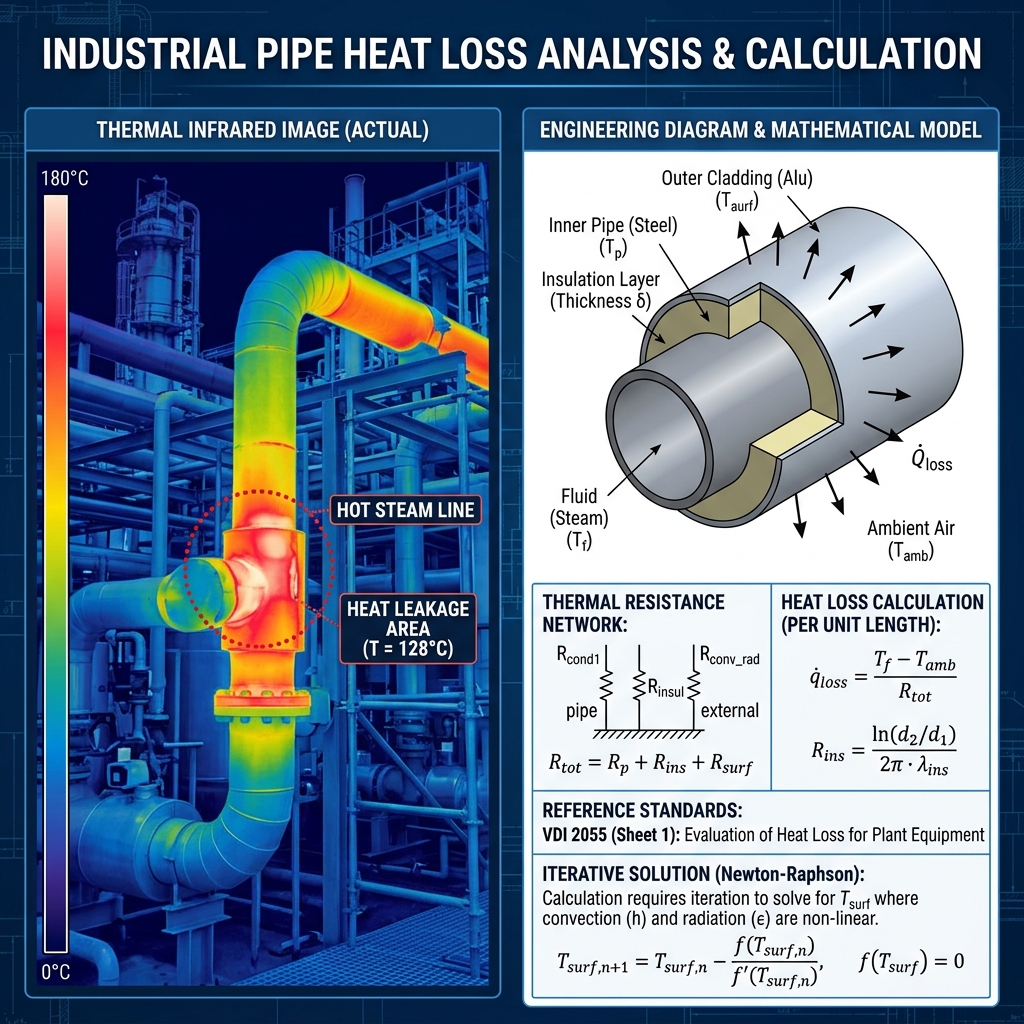
Industrial Heat Loss Calculation Guide: VDI 2055 and ISO 12241 Standards
Industrial Heat Loss Calculation Guide: Engineering Standards and Energy Savings
Energy efficiency in industrial plants is not just about reducing costs; it is the cornerstone of operational sustainability and carbon footprint reduction. Accurately calculating thermal losses in pipelines, tanks, and flat surfaces is the first step in a correct insulation strategy.
In this guide, as the Deta Industry engineering team, we detail the complex mathematical models and international standards (VDI 2055, ISO 12241) behind heat loss calculations.
1. The Importance of Standards in Heat Loss Calculation
Simple heat conduction formulas do not fully reflect real field conditions. Two main standards are taken as reference in the industrial world:
- VDI 2055: The most comprehensive German engineering standard determining the thermal performance and economic insulation thickness of insulation materials.
- ISO 12241: An international standard specifying heat transfer calculation methods for pipelines and equipment.
These standards account not only for the conductivity of the insulation material but also for the emissivity of the outer cladding, ambient wind speed, and convectional currents.
2. DetaTherm Algorithm: Why Iterative Calculation?
The biggest challenge in calculating heat loss is that the outer surface temperature (Ts) is unknown. The outer surface temperature depends on both the heat passing through the insulation and the convection and radiation losses to the external environment.
To solve this problem, our DetaTherm calculation engine uses Newton-Raphson Iteration. This process works as follows:
- A surface temperature is estimated.
- Radiation and convection coefficients are calculated based on this temperature.
- The result is repeated thousands of times until heat conduction balance is achieved.
In this way, real surface temperature and heat loss data are reached with an accuracy of 95% and above.
3. Parameters and Their Effects
Critical parameters to consider when using our calculation tool:
Thermal Conductivity Coefficient (Lambda - λ)
The lambda value is not a fixed number. As temperature increases, the lambda value of materials such as rock wool or polyurethane also increases. DetaTherm selects the most accurate conductivity value by interpolating Dynamic Lambda according to the fluid temperature.
Emissivity (ε)
The outer cladding material (Aluminum, Galvanized, Stainless, etc.) directly determines radiative heat loss. For example, a shiny aluminum jacket (ε ≈ 0.05) emits much less radiation and increases energy savings compared to a painted surface (ε ≈ 0.90).
4. ROI (Return on Investment) Analysis
Insulation is an investment, not an expense. A correctly calculated insulation project usually pays for itself in a short period of 3 to 8 months. Factors affecting the payback period:
- Fuel unit price (Natural gas, electricity, etc.)
- Annual operating hours of the facility (e.g., 8760 hours)
- Application cost of insulation
5. OHS (Occupational Health and Safety) Dimension
Heat loss is not just about energy. For personnel safety, the outer surface temperature is generally required to be below 50°C. DetaTherm automatically warns you if the surface temperature is above this limit as a result of the calculation.
Start Calculating Now
If you want to create a professional report for the pipelines or tanks in your own facility, you can use our DetaTherm tool.Conclusion
Correct insulation starts with correct engineering. Calculations made in accordance with VDI 2055 standards maximize the energy efficiency of your facility while minimizing operational risks. You can always contact the expert staff of Deta Industry for your technical questions or our on-site thermal imaging service.
Deta Scaffolding Team
This content has been prepared and verified by Deta Industrial technical experts.