
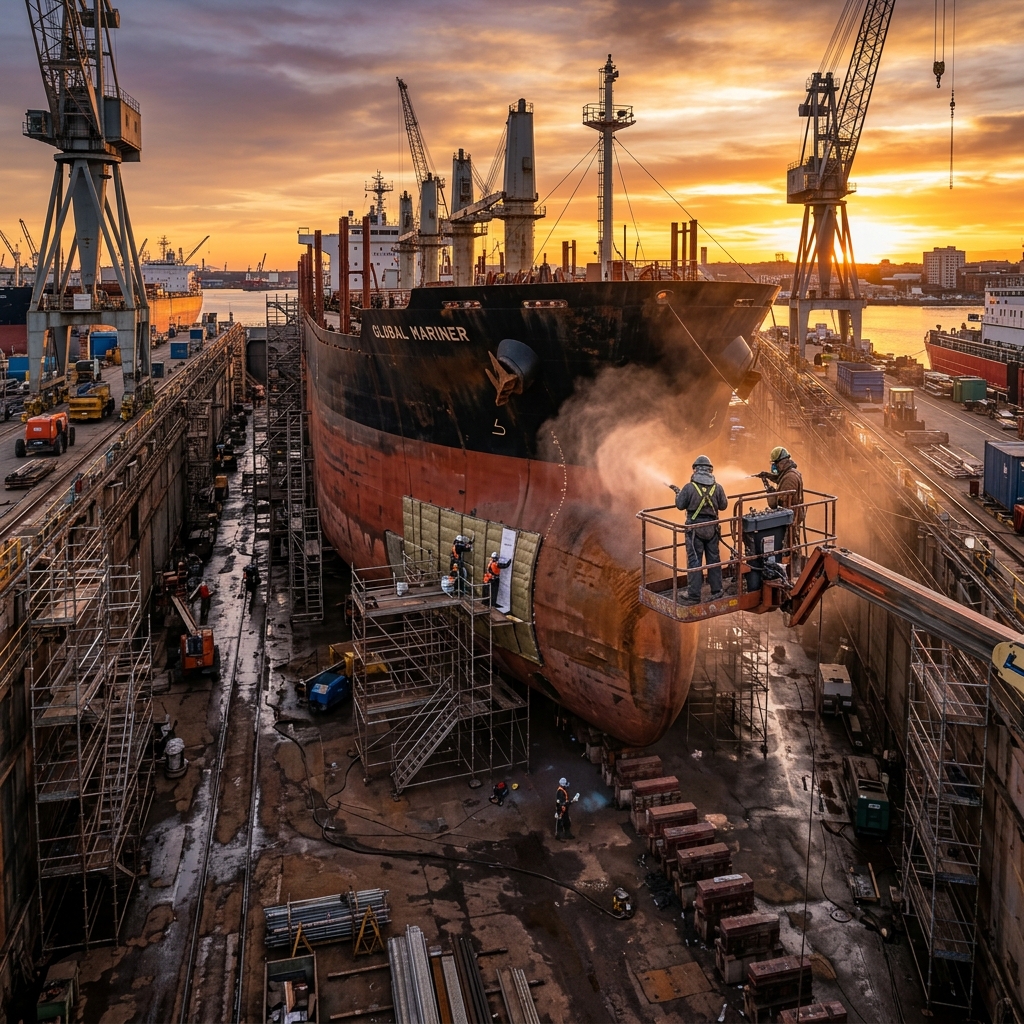
Corrosion Control, Ship Insulation and Scaffolding Engineering in Marine Standards
Corrosion Control and Ship Insulation Engineering in Marine Standards: Shipyard and Heavy Industry Guide
Shipbuilding and maintenance (marine industry) is one of the environments with the most aggressive corrosion conditions on earth. Saltwater, high humidity, strong winds, and chemical exposure initiate a relentless corrosion process on ship hulls, tanks, and pipelines. The way to stop this destructive effect is through high-level surface preparation, marine-standard corrosion control, and flawless ship insulation engineering.
However, carrying out insulation and painting processes for a container ship [1] or a massive shipyard project requires forced safe access to the structure. Corrosion control in the marine environment is not only a chemical process but also an integrated engineering operation that requires correct scaffolding planning, safe access, and digital process management. In this article, we will examine the technical infrastructure of corrosion control in shipyard conditions, insulation scaffolding standards, common field errors, and how our DetaTherm and DetaPlan software optimize these challenging processes.
Internal Link Suggestion: Industrial scaffolding installation standards can be linked. Internal Link Suggestion: Corrosion resistant material selection guide can be linked.
📌 Summary: What is Insulation and Corrosion Scaffolding in Shipyards? (Featured Snippet Targeted)
Shipyard insulation and corrosion scaffolding are temporary access structures built for the safe execution of sandblasting, painting, and industrial insulation (ETICS) applications in shipbuilding, maintenance, and dismantling works. They are special engineering structures coated with hot-dip galvanization in accordance with EN ISO 1461 and DAST 022 standards against the high corrosion risk of the marine environment [2-4]; built under the supervision of a naval architect [5, 6] and resistant to high wind and vibration loads.
1. Technical Anatomy of Corrosion Control in Marine Environment
The protection of steel surfaces in shipyards must be meticulously planned according to corrosion classes (C1, C2, C3, etc.). The quality of the insulation and protective coating applied to the ship surface is directly connected to the quality of the scaffolding the personnel performing the process stands on.
Galvanization and Coating Standards
Scaffolding and access equipment to be used in marine environments must resist corrosion just like the ship itself. According to standards, for C3 corrosion class protection suitable for marine and high humidity environments, hot-dip galvanization according to the EN ISO 1461 standard is mandatory, and the coating thickness must be at least 50 µm by legal technical requirement [7]. For less risky areas (C2 class), this thickness should be at least 28 µm [7]. While main steel components are hot-dip galvanized according to EN ISO 1461 and DAST 022 guidelines, small fasteners such as bolts, nuts, and pins must be galvanized according to the EN ISO 4042 norm [2, 3, 7].
ETICS (External Thermal Insulation Composite Systems) and Anchorage
In insulation processes performed in ship superstructures (living quarters, etc.) or heavy industrial buildings in shipyard facilities, fixing the scaffolding to the structure (anchorage) is a big problem. Special ETICS connection rods are used to make safe binding over thick insulation layers. In advanced systems, safe anchorage can be performed without breaking the structural integrity over insulation layers up to approximately 300 mm thick with ETICS rods [8].
2. Field Application Process and Naval Architecture
Scaffolding installation in shipyards differs from standard construction projects. The complex curves and variable geometry of the ship hull should be modeled and optimized using the finite element method (FEM) (for example, like a container ship skeleton modeled with JIFEX software) [1].
By regulations, the processes of installing, dismantling, or making significant changes to scaffolding in shipbuilding and dismantling works in shipyards are strictly carried out by or under the supervision of a naval architect [5, 6]. This is the most critical rule of occupational safety in the marine field.
3. Top 3 Critical Errors Made in Shipyards and Insulation Sites
Although theories in books are perfect, the realities of heavy industry and shipyards are different. The errors we most frequently encounter in the field that undermine corrosion/insulation processes are:
- Error: Using Materials Not Suitable for Corrosion Class Field Reality: Using C1 (only painted) class scaffolding or substandard rusted elements despite the salty and aggressive air by the sea, thinking it is a temporary job [7]. Cracked, broken, and worn scaffolding elements succumb to corrosion and cause the structure to collapse [9, 10].
- Error: Incorrect Stacking of Insulation Materials on Scaffolding Field Reality: Irregular stacking of paint cans, sandblasting equipment, or insulation panels on work platforms. Overloading the scaffolding without calculating the load class (e.g., Class 2 or Class 3) damages the structure; also, leaving construction materials to create a load on the temporary edge protection system (guardrails) is against regulations [11].
- Error: Incorrect Application of ETICS Rods Field Reality: Using standard short anchor screws to connect the scaffolding through 200 mm or 300 mm thick insulation blocks [8]. This situation prevents the scaffolding from holding onto the building/ship and causes it to collapse under wind load.
4. Marine Risks and Safety Scenarios
Risks are asymmetric in insulation sites exposed to offshore winds and the dynamic environment of the shipyard.
- Risk Scenario 1: Sail Effect and Wind Load During sandblasting and painting processes, scaffolding is covered with tarpaulins (e.g., Keder tarpaulins) or nets to prevent particles from spreading to the environment [12, 13]. However, this covering turns the scaffolding into a massive sail. The risk of a system covered without wind load calculation, especially in storms, tearing off the anchors and collapsing is very high in open shipyard areas [14].
- Risk Scenario 2: Falling Objects in Multi-Layered Works Different levels of work are carried out simultaneously in shipbuilding and repair facilities. Every shipbuilding, repair, and maintenance facility must develop control strategies to protect employees from the risks posed by falling objects [15]. Not attaching toe boards (at least 15 cm) [16] causes sandblasting nozzles or insulation scissors to fall onto personnel working on lower floors.
5. Cost Impacts and Scaffolding Planning
Lack of planning in corrosion control and insulation projects is not only a safety risk but also a massive financial black hole.
- Cost Impact 1: Equipment Decay Due to Incorrect Corrosion Protection The absence of galvanization according to the EN ISO 4042 norm on the connection parts of the scaffolding equipment brought to the shipyard [2] causes the parts to lock and rust rapidly in the salty environment [9]. Assembly and dismantling times are prolonged, and depreciation costs skyrocket due to materials becoming unusable.
- Cost Impact 2: Logistics and Scaffolding Planning Waste In areas where space is very valuable, such as dry docks, incorrect scaffolding planning causes more or fewer parts than necessary to come to the field. Every extra pallet waiting around the ship slows down crane and forklift traffic, doubling and increasing operational downtime costs [17].
6. Top 3 Professional Tips from the Expert
Professional safety tips based on our field experiences, suitable for the YMYL (Your Money or Your Life) concept:
- Periodically Test Protection Nets: Scaffolding tarpaulins and edge protection nets (meshes) prevent materials from falling from the scaffolding level [12]. However, these nets can lose their flexibility due to sun and sea salt. As a legal and technical requirement, edge protection nets should be checked annually and test nets should be sent to the laboratory to confirm the breaking strength of the yarns [18].
- Integrate System Lattice Girders (FW): It is impossible to get support from the ground in complex propeller, shaft, or stern geometries. To insulate these areas, create wide bridging without support using special lattice girder (FW) systems [19].
- Use Temporary Roofs Against Weather Conditions: To prevent insulation and coating work on the ship deck from being affected by rain or snow, turn the work area into an enclosed factory using aluminum or steel cassette roofs, or Keder tarpaulin systems. This prevents work from stopping [13, 20].
7. Software Integrations: DetaTherm and DetaPlan
Modern ship insulation and scaffolding access are now managed over digital twins rather than on paper. Our specific software solutions that we have developed to maximize efficiency in your projects are coming into play.
Our DetaTherm Program: Our DetaTherm program, which we have developed specifically for heat transfers, corrosion progression rates, and performance analysis of insulation layers in ship insulation engineering (integrated into sectoral generalizations), simulates the life of the insulation. It tracks how much paint/coating resistance is formed in which corrosion class and optimizes the performance of the material in the marine environment digitally.
Scaffolding Planning with DetaPlan: Adapting the scaffolding to be installed for the insulation process to the complex ship geometry requires a flawless scaffolding planning software. Although there are various software such as LayPLAN working on AutoCAD [21] in the market; DetaPlan, which we use in our projects, performs collision detection over the 3D modeling of the ship hull. It prevents logistic confusion in the shipyard by calculating the scaffolding quantity to go to the site with millimetric precision. A scaffolding planning process made with DetaPlan guarantees that the sandblasting and painting teams reach every point of the ship in the most ergonomic way.
Internal Link: Check our Shipbuilding Sector Solutions.
Conclusion and Call to Action
Corrosion control and ship insulation engineering in the marine environment require galvanized equipment that resists heavy salt damage, EN ISO 1461 standards [2], and zero-error-tolerant access solutions. A successful insulation coating depends on a solid scaffolding the team performing that coating stands on and digital software optimizing that scaffolding.
If there is a planned maintenance, dismantling, or new construction project in your shipyard; contact our engineering team today to analyze your corrosion processes with DetaTherm and design your ship access systems with DetaPlan. There is no room for risk in heavy industry, trust the power of engineering.
Frequently Asked Questions (FAQ)
1. Who performs the legal inspection of scaffolding operations in shipyards? By regulations, in shipbuilding, maintenance, repair, and dismantling works; the processes of installing, dismantling, or making changes to scaffolding must be performed by or under the supervision of a naval architect [5, 6].
2. What is C3 Corrosion class and how should scaffolding materials be coated? For the C3 corrosion class, which expresses heavy conditions such as marine areas and high humidity environments, the steel scaffolding elements to be used must be hot-dip galvanized according to the EN ISO 1461 standard, and the average coating thickness must be at least 50 µm [7].
3. How is scaffolding anchorage provided while doing insulation on a ship? ETICS (External Thermal Insulation Composite Systems) connection rods are used to safely bind to the building or ship construction over thick insulation (e.g., between 200 mm - 300 mm) [8]. These rods transfer the static load to the main body without crushing the insulation.
4. What do DetaTherm and DetaPlan programs do in corrosion control? DetaTherm allows you to digitally analyze the thermal and structural efficiency of ship insulation and corrosion barriers; while DetaPlan provides scaffolding planning and logistics optimization by designing industrial scaffolding to be used by the teams performing these operations in 3D.
5. What precautions should be taken against falling object risks in shipyards? Shipbuilding and repair facilities are multi-layered working areas [15]. For falling sandblasting tools or parts, toe boards (skirting) at least 15 cm high must be attached to the edges of the working platforms in scaffolding [16] and edge protection nets (meshes) in appropriate standards should be used [12].
6. How often should scaffolding outer protection nets (meshes) be checked? Scaffolding edge protection nets exposed to heavy marine climate, humidity, and UV rays should be checked periodically every year. The maximum tensile strength of the net yarns should be tested, and those that are worn, have lost their elasticity, or are corroded should be replaced immediately [10, 18].
Deta Scaffolding Team
This content has been prepared and verified by Deta Industrial technical experts.