
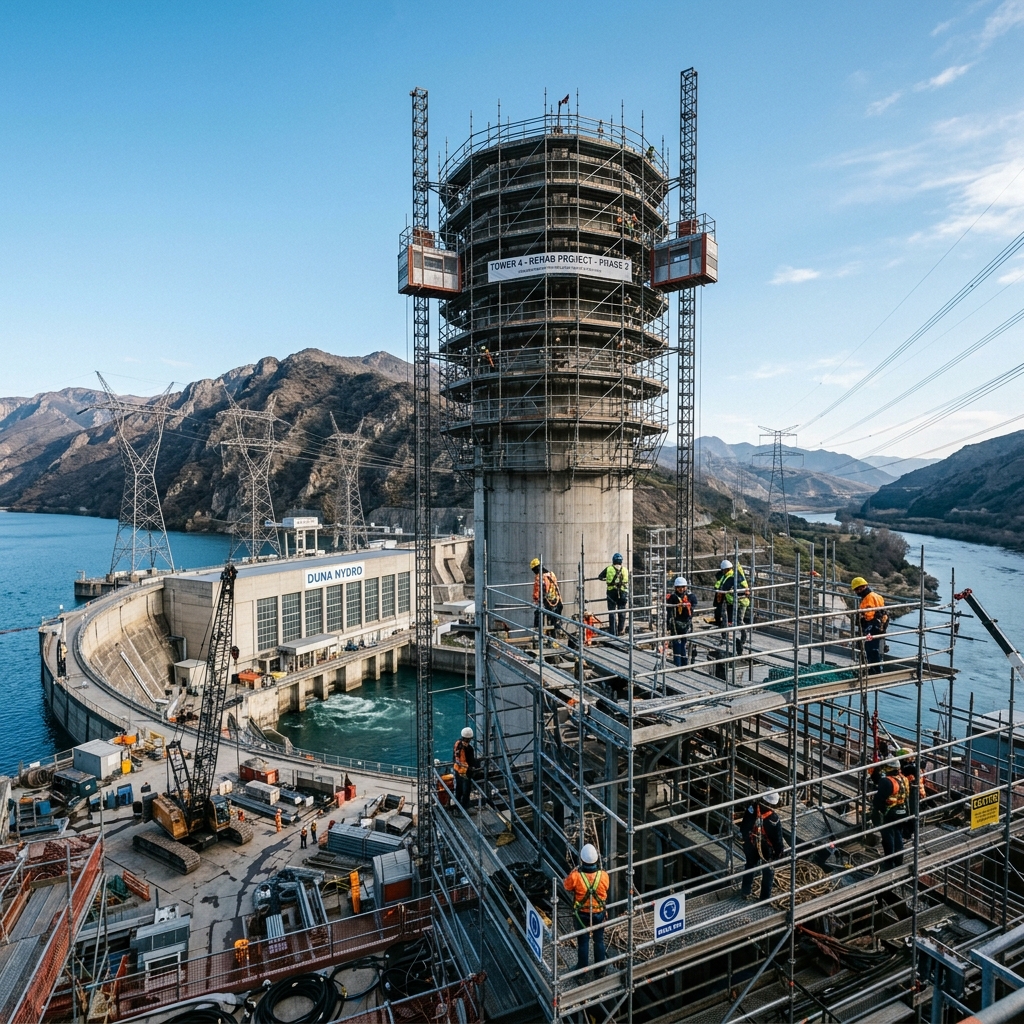
Scaffolding Installation in Power Plants: Zero Tolerance Safety Guide for High Voltage
Scaffolding Installation in Power Plants: Zero Tolerance Safety Guide for High Voltage
For project managers, procurement specialists, and site managers, power plants are one of the most challenging and risky areas of industrial construction. Whether it is a massive hydroelectric dam or a wind turbine, power plants are areas where heavy concrete, massive loads, and high-voltage lines coexist. In such areas, facade scaffolding installation is not just about building an access platform, but also about creating an engineering shield that will protect personnel from fatal electric shocks and massive structural collapses.
In accordance with YMYL (Your Money or Your Life) criteria, there is no place for hearsay in this critical area that directly affects human life. A static calculation error or an overlooked earthing detail at power plant sites leads not only to financial losses but also to irreparable loss of life. In this in-depth expert guide, we examine the installation processes of facade scaffolding and heavy-duty load towers (TG 60, etc.) in power plants, standards, and the power of digital planning tools.
Definition: What is Facade Scaffolding in Power Plants?
Facade scaffolding refers to temporary structure systems installed for plastering, painting, repair, or construction outside structures. In power plants, this definition covers high-capacity, earthed steel or aluminum modular systems ranging from the construction of power plant chimneys to the maintenance of generator turbines and insulation work around high-voltage lines.
Detailed Technical Explanation: Plant Standards and Heavy Loads
Scaffolds to be used in power plants must be manufactured in accordance with EN 12810-1 and EN 12811-1 standards.
Heavy Loads and TG 60 Load-Bearing Scaffolds
In power plants, in addition to standard facade scaffolds, it may be necessary to install heavy-duty load-bearing scaffolding systems to absorb high loads. Systems such as Allround TG 60 reliably absorb loads up to 25 tons per meter, providing optimum adaptation to difficult geometric situations.
Scaffolding Application and Installation Process in Power Plants
- Risk Assessment and Planning: The distance of the scaffold to energy lines is evaluated.
- Geotechnical Survey and Base Plates: The ground must be leveled and brought to the strength to carry the loads.
- Starting Node and Erecting Standards: Using flange (wedge-rosette) systems, adaptation is provided to the complex pipe or turbine geometries of the plant.
- Bracing: Diagonal reinforcements are installed to prevent lateral movement of the system under wind or working loads.
- Anchorage (Stabilization): To prevent toppling, stabilization is performed every 4 meters starting from the lowest level.
- Earthing: Scaffolding earthing and electrical safety is the most critical step in power plant sites. Scaffolds must be earthed with conductors of appropriate cross-section.
- Platforms and Edge Protections: Toe boards and guardrails are fully installed.
The 3 Most Common Critical Errors on Power Plant Sites
- Ignoring Electrical Hazards: Due to high current, voltage induction may occur on the scaffold. Forgetting earthing is the biggest field error.
- Incorrect Ground Support: Not placing base planks under the scaffold feet to distribute the load creates a risk of collapse.
- Unconscious Removal of Bracing and Anchoring: A single piece removed "to make work easier" destroys the stability of the system.
Risk Scenarios and Safety Management
Risk Scenario 1: Contact or Induction with High Voltage Lines The distance to the conductor and the voltage determine the risk of induction. Contact of metal pipes with the line leads directly to death.
Risk Scenario 2: Wind Load and Sail Effect In plants in open terrain, scaffolds covered with tarpaulin create a "sail effect" and can topple. This situation must be included in the EN 12811-1 wind load calculations.
3 Professional Tips for Work Safety in Power Plants
- Earthing Control: If a potential of more than 30 volts is measured between the scaffold and the ground 5 meters away, earthing must be done immediately.
- Scaff-tag (Labeling): The green/red tag system showing the inspection status of the scaffold must be applied without compromise.
- Safety Distances: In high-voltage lines between 170-420 kV, a minimum horizontal distance of 5 meters must be left between the scaffold and the line.
DetaPlan Integration: Digital Revolution in Scaffolding Planning
Manual calculations should be abandoned to ensure operational efficiency in heavy industry and power plants. Thanks to LayPLAN and 3D scaffolding modeling approaches, you can digitalize your plant projects.
By using our advanced engineering software such as DetaPlan and DetaTherm:
- You can transfer the 3D model of the plant to the system and perform clash analyses before the site.
- You prevent logistics waste by generating a Bill of Materials (BOM) with 100% accuracy.
- Most importantly, since these tools are completely FREE, you add a budget-friendly and high engineering-oriented solution to your project.
Frequently Asked Questions (FAQ)
1. Which scaffolding standards are valid in power plants?
Certified materials complying with EN 12810 and EN 12811 standards must be used.
2. What is the minimum safety distance near high voltage lines?
For lines up to 420 kV, the horizontal distance between the scaffold and the line must be at least 5 meters.
3. What is the biggest benefit of scaffolding planning software (DetaPlan, etc.)?
It prevents clashes with 3D modeling and reduces costs by providing a free and exact material list (BOM).
Free Engineering Support for Your Plant Project
As Deta Endüstri, we offer the safest scaffolding solutions in your power plant projects. Digitalize your project immediately with our free **DetaPlan** software.Deta Scaffolding Team
This content has been prepared and verified by Deta Industrial technical experts.