
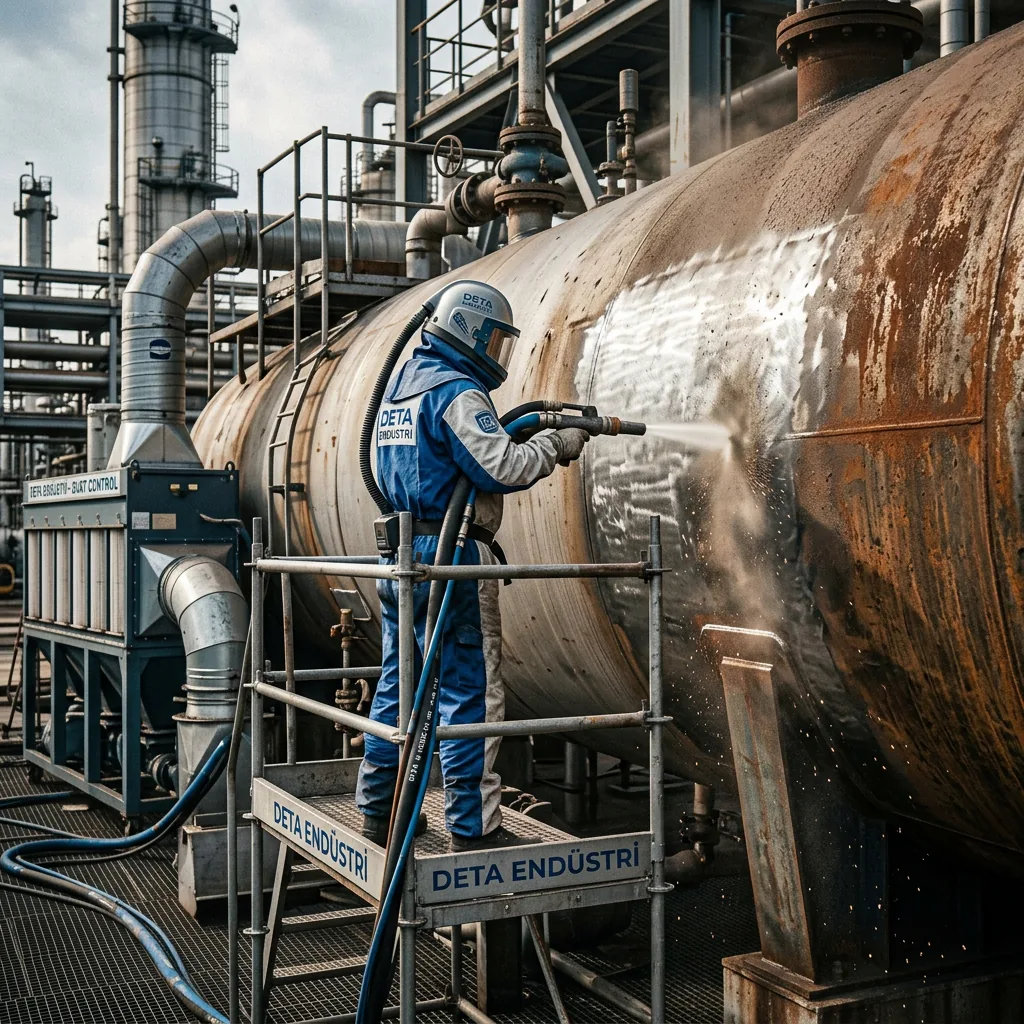
What is Industrial Sandblasting? Guide to Quality, Durability and Longevity in Surface Preparation
Introduction
The success of painting, coating, and insulation applications in industrial facilities depends 70% on surface preparation. At the heart of this preparation are Industrial Sandblasting operations. In refinery, petrochemical, and power plant projects, incorrectly performed sandblasting causes the paint not to hold, leads to early corrosion, and increases the maintenance costs of million-dollar facilities.
What is Sandblasting?
It is the process of cleaning and roughening metal surfaces with the help of abrasive materials (grit, shot, garnet, etc.) sprayed with high-pressure air. Its purpose is to clean rust, remove old paint, and create a "holding profile" for the new coating.Sandblasting Standards and Quality Criteria
The sandblasting process is classified and inspected according to internationally accepted standards (ISO 8501-1).
Sa 2.5 Standard
The most common standard used in industrial projects. It implies that the metal surface must be almost completely cleaned, appearing in a gray-white metal color.Anchor Profile
The micron-level roughness that increases paint adhesion. The wrong profile leads to paint peeling or insufficient protection.Abrasive Selection
Grit, Shot, or Garnet selection is determined by engineering experience according to the hardness of the surface and the targeted cleaning quality.Humidity Control
The metal surface is very active after sandblasting. It rusts quickly in humid environments (flash rust). Therefore, the time after sandblasting and before painting must be managed very well.Occupational Safety and Modern Application Techniques
Since sandblasting involves high pressure and dust, it is subject to the strictest HSE rules.
- Protective Equipment: Air-supplied sandblasting helmets and special abrasion-resistant clothes are mandatory for operators.
- Vacuum and Dust-Free Systems: Modern technologies that minimize dust formation for environmental sensitivity and confined space works are preferred.
- Robotic Sandblasting: Autonomous systems providing more homogeneous cleaning for large areas and tank interiors increase efficiency.
MISTAKE: Leaving Dust on Surface
Even the finest dust layer remaining on the surface after sandblasting prevents the paint from adhering to the metal. A "dust test" with compressed air or vacuum must be performed before painting.Conclusion: Sandblasting is the Basis of Quality
Sandblasting is not a "preparation" stage; it is the foundation on which the entire coating system sits. Correct surface preparation can increase the life of the paint system up to 3 times and provides complete protection against corrosion.
Deta Painting Team
This content has been prepared and verified by Deta Industrial technical experts.