
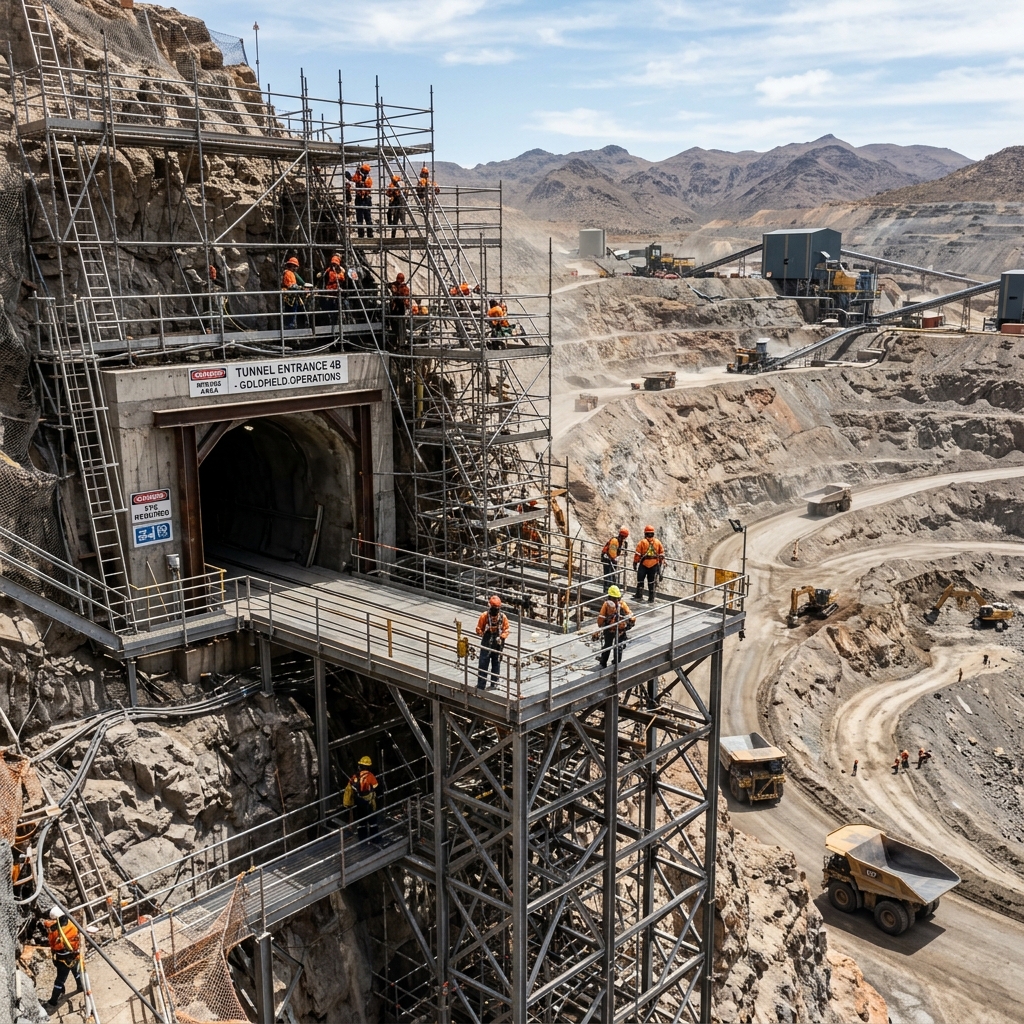
Scaffolding Installation in Mines: Safety and Operations Guide for Gold and Copper Sites
Scaffolding Installation in Mines: Safety and Operations Guide for Gold and Copper Sites
For project managers, procurement specialists, and site managers, mining sites are locations where engineering limits are tested at the most extreme points. Especially in the gold and copper mines located in the challenging topographies of Turkey (open-pit facilities, underground gallery entrances, enrichment plants, etc.), facade scaffolding installation is a much more complex process than a routine construction job. Underground tunnels and sub-surface constructions require special tools and reinforcement work for activities on tunnel ceilings.
Deta Endüstri: For project-specific solutions and detailed information, you can review our Industrial Scaffolding Rental and Installation Services page.
In these massive industrial facilities, the collapse of a scaffold is not just a financial loss; it is a critical crisis that directly threatens life safety, in accordance with YMYL (Your Money or Your Life) principles. The construction of facilities, insulation of cylindrical tanks, or fortification work at deep tunnel entrances require a flawless engineering and scaffolding planning process. In this guide, we examine facade scaffolding installation processes, standards, site risks, and the integration of digital planning tools into your projects in detail, in light of the challenging dynamics of the mining sector.
Definition: What is Facade Scaffolding Installation in Mines?
Facade scaffolding installation is the process of integrating pre-manufactured steel or aluminum components, compliant with EN 12810 and EN 12811 standards, into a structure to create a safe working environment for the construction, maintenance, and repair of buildings, enrichment plants, tunnel entrances, and other structures at mining sites. In mines, flanged (wedge-connected) "Allround" modular scaffolding systems, which can adapt to narrow spaces, complex geometries, and high load capacities, are preferred.
Detailed Technical Explanation: Standards and Mining Conditions
Facade scaffolds used at mine sites cannot consist of randomly selected metal pipes. It is a legal requirement that the scaffolds to be used have a certificate of conformity to harmonized national and international standards (TS EN 12810-1 and TS EN 12811-1).
Load Classes
The correct load class must be determined by considering the probable loads that may be placed on the scaffold according to its intended use. Since operations such as sandblasting, heavy insulation, tunnel reinforcement, and machinery assembly are carried out in mines, systems with Class 4 (3.0 kN/m²), Class 5 (4.5 kN/m²), or Class 6 capacity for heavy-duty load towers should generally be projected.
Connection Technology
Gold and copper mine facilities contain complex pipelines, conveyor belts, and reactor tanks rather than flat walls. Flanged connection technologies, which work with a hammer blow over a wedge and offer connection possibilities in eight different directions, provide flexibility and positive connection (locking) in such difficult geometries.
Application Process: Steps for Scaffolding Installation in Mines
The installation process at mine sites starts at the design stage and is applied with strict discipline on-site:
- Risk Assessment and Planning: A project plan is prepared by analyzing where the scaffold will be installed, for what purpose it will be used, ground conditions, and wind/weather conditions in advance.
- Geotechnical Survey and Base Plates: The ground at mine sites is usually soil, mud, or crushed stone. On unstable ground, the area of the base plate (jack) must be at least 150 cm², and base planks (timber, etc.) made of suitable material must be placed under them to distribute the load. Ground strength is of critical importance, especially for underground tunnel scaffolds.
- Starting Node and Adjustment Spindles: Base plates (adjustment spindles) with adjustable verticality are placed to find the balance of the system. The safe limit of the jack opening (e.g., maximum 200 mm adjustment capacity) must not be exceeded.
- Erecting Standards, Ledgers, and Bracing: After the first level is leveled, the system is built with longitudinal and transverse intermediate connections. Longitudinal and transverse diagonal (bracing) connections are installed as stipulated by the TS EN 12811 standard to prevent the system from moving as a whole or toppling.
- Platforms and Side Protections: Platforms are fixed so that no gaps remain on the working floors. To prevent material and people from falling, toe boards (skirtings) and main/intermediate guardrails against falling are mounted at least 15 centimeters above the highest level of the working platform.
- Anchorage (Stabilization): Except for independent and suspended systems, the scaffold is fixed to the existing structure through appropriate anchoring elements, taking the manufacturer's instructions into account, to prevent movement, collapse, or toppling.
The 3 Most Common Critical Errors on Site
Fatal errors frequently encountered by site managers and foremen at mine sites that endanger work safety are:
- Neglecting Ground Support: Not placing base planks under the lower adjustment spindles to distribute the load on soil or muddy mine grounds causes the scaffold to sink into the ground when loaded and the system to collapse.
- Use of Defective or Modified Parts: The insistence of workers on-site to cut scaffold pipes to save time or "fit parts," or to continue using components that are corroded, cracked, or deformed (lost cross-section), zeros out the load-carrying capacity.
- Insufficient Bracing and Anchoring: Not connecting the system to the structure with anchoring, thinking "it's a short-term job anyway," leads to the system collapsing laterally under wind or working loads.
Risk Scenarios and Safety Management
Weather conditions and heavy industrial environments create serious risks at mine sites:
Risk Scenario 1: Collapse Under Strong Wind and Storm Open mine sites or enrichment plants in valleys are under a high wind tunnel effect. A facade scaffold exposed to strong winds due to risks arising from adverse weather conditions carries a risk of toppling if it does not have sufficient anchoring points.
Risk Scenario 2: Falling Materials from Height Heavy tools, bolts, or construction waste used in the construction of gold and copper mine facilities can fall from scaffolds where toe boards (skirtings) have not been placed or gaps have been left between platforms.
3 Professional Tips to Perfect Scaffolding Installation
- Apply Scaff-tag Systems Without Compromise: Scaffolds that have been completed, checked, and are suitable for use should be marked with a green tag, while those that are unsuitable should be marked with a red tag.
- Strictly Follow Earthing Rules: Metal scaffolds must be earthed with conductors and plates of appropriate cross-section against the danger of induced voltage.
- Integrate Workers with Fall Protection Equipment: All scaffolding personnel must use full-body fall protection harnesses (parachute type) and lanyards.
DetaPlan Integration: Digitalizing the Scaffolding Planning Process
The era of manual drawings in today's heavy industry and mining projects is over. It is vital to activate DetaPlan scaffolding planning software to win the competition on-site and zero out operational errors.
Thanks to DetaPlan:
- You can transfer 3D models of the massive tanks and tunnel lines of your copper or gold mine to the software and build the scaffold virtually on a digital twin.
- You prevent time loss by detecting physical clashes that may occur in difficult geometries in the computer environment in advance.
- You minimize logistics costs by generating a Bill of Materials (BOM) with zero error margin.
Frequently Asked Questions (FAQ)
1. Which standards should be followed during the installation of facade scaffolding in mines?
Scaffolding systems must comply with TS EN 12810 and TS EN 12811 standards, and the documents must be kept on-site.
2. How should the scaffold foot (base plate) be placed on muddy grounds?
Base planks (sole boards) made of solid material (hardwood, etc.) should be placed under the jack base plates to distribute the load.
3. What is the benefit of DetaPlan software for site managers?
It prevents clashes with 3D simulation, provides an exact material list, and verifies static resistance in the digital environment.
Get Professional Support for Your Scaffolding Project
Do not risk your scaffolding operations at your mine sites. As Deta Engineering, we are at your side with our expert staff and DetaPlan software.Deta Scaffolding Team
This content has been prepared and verified by Deta Industrial technical experts.